My top five OCD-taming tips in celebration of the five-year anniversary of my memoir, Is Fred in the Refrigerator? Taming OCD and Reclaiming My Life!
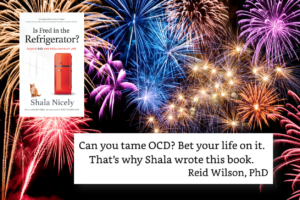
1. Don’t buy OCD’s bravado, because you can tame OCD
At its worst, my OCD was something I called the Triad of Hell:
As I conceived it, the Triad of Hell spun three characters into one: Gollum from Lord of the Rings, obsessed with his precious ring—or in my life, with anything that could bring harm; the Looney Tunes Tasmanian Devil, hypervigilant, whirling around searching for the next thing that could kill us; and a Harry Potter-styled dementor, utterly preoccupied with scenes of soul-destroying death and destruction. (p 184, Fred).
When you’re facing off against your own Triad of Hell, OCD will do everything in its power to convince you that you’re fighting an unwinnable war. And it’s right….if you play OCD’s game. But like I learned from Dr. Reid Wilson, who wrote the Afterword to my memoir, if you switch to a different game—one where you are purposely making yourself feel anxious and uncertain—well, now you’ve got a game that you can win and a monster that you can tame.
2. Aim for imperfection in your recovery journey
I have two memories of my experience sharing “Is Fred in the Refrigerator?” [as the keynote speaker] at the [2013 IOCDF] conference. The first is that when I delivered one of my closing lines, I flubbed my words, saying “ERP” when I meant “OCD.” Realizing my mistake, I stopped mid-sentence, smiled, said what I’d meant, then kept going. It was a tiny mistake, probably not my only one and one that likely didn’t even register with the audience. To me, however, it was one of the most important moments of the keynote because it was imperfect. Imperfection was what my OCD had been afraid of. It had happened, and we’d survived (p. 206-208, Fred).
Since OCD always wants what it can’t have—such as perfection, certainty, control, and comfort—it makes sense that OCD would want all of us to do our exposure and response prevention (ERP) therapy perfectly, and then shame us when we can’t hit that mark. But trying to do therapy perfectly is letting OCD direct your recovery. Instead, I like aiming for imperfection, as that’s something I know I can achieve.
In fact, one of the goals of my advocacy has been to demonstrate imperfection in my life and recovery because that’s reality. Because as Tom Magliozzi, co-host of NPR’s Car Talk, once said:
Happiness = Reality – Expectations
3. Be nice to yourself along the way
My discovery of self-compassion was revolutionary in changing my view of myself. I’d been self-critical my whole life because OCD was so demeaning, and I’d unconsciously made its perspective my own. Which is not surprising, because having lifelong, untreated OCD is akin to living for decades with an abusive partner. I’d internalized the mistreatment my partner constantly delivered: I must deserve it, or it wouldn’t keep happening. Learning to be mindful and to step back from thoughts and see them as just that—thoughts, not facts—combined with being able to give myself compassion, combatted my mind’s innate tendency to be, at times, an abusive jerk. (p. 243, Fred).
Take the assessment to see how self-compassionate you are, and then read my self-compassion blog posts to learn how you can make self-compassion one of the most powerful weapons in your recovery arsenal.
4. Remember that you’re not alone
Have you ever had a day like this?
In the past day alone, I’d spent hours obsessing over a conversation I’d had with a colleague whom I was sure I’d offended; reread an email to Joan, the CEO, more than ten times before hitting “Send” to ensure I hadn’t accidentally inserted “f*!k” into the verbiage; gunned my car through a yellow light because my mind told me something bad would happen if I saw it turn red; and thrown away an entire package of strawberries I’d sliced for a dessert I was making for my seventy-year-old neighbors, because I couldn’t be sure I hadn’t somehow contaminated it in a way that would overpower their surely compromised immune systems. (p. 112, Fred).
Yeah, me, too. But oftentimes people with OCD don’t know that these types of exhausting and compulsion-filled days are par for the course if OCD is untreated. Instead, we just think we’re losing our minds. All. By. Ourselves. And if OCD can make us feel isolated, that empowers it to be an even bigger Triad of Hell.
One of the main reasons I wrote Fred was because I wanted you to know that you aren’t alone. Because you aren’t. You are part of a global community of OCD-tamers, and together, supporting one another, we can reclaim our lives.
5. Don’t ever, ever give up!
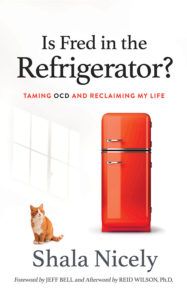 Fred is written in the style of a classic suspense novel (OCD is the villain, of course) because that’s unfortunately what living with untreated OCD felt like as I tried and failed repeatedly to get the right treatment.
Fortunately, with the advances in information available about OCD and more qualified therapists now providing ERP, the evidence-based therapy for OCD, you don’t have to take the same suspense-novel like approach to your own OCD recovery. You can find an OCD/ERP therapist (either in-person or virtual), and there are quite a few self-help courses available as well, including Kimberley Quinlan’s Your OCD Toolkit and Dr. Reid Wilson’s OCD & the 6-Moment Game: Strategies & Tactics. You can find even more self-help resources on my Get Unstuck page and on the IOCDF website.
The process of recovering from lifelong mental illness is often two steps forward, one step back. OCD frequently tells me that had I done something differently, the outcome would have been faster or better, but that’s one of its biggest lies. … Things are as they are. I am who I am. I am where I am. I’m in the arena, fervently and self-compassionately working to break the compulsive shackles that keep me from being free (p. 252, Fred).
Learn more about taming OCD
To learn more about how I used ERP to tame OCD and reclaim my life—including Dr. Reid Wilson’s Afterword, where he offers powerful guidance for how you can apply my OCD-taming strategies in your daily life—read or listen to Is Fred in the Refrigerator? Taming OCD and Reclaiming My Life. Click here to purchase a copy.
Firework photo credit © Can Stock Photo / Smileus