
Untreated OCD can be a painful condition to bear. I wrote about my own experiences with the disorder in Is Fred in the Refrigerator? Taming OCD and Reclaiming My Life because I wanted people who had loved ones with OCD to understand how earth-shatteringly painful it can be and because I wanted people with OCD to know they are not alone in their experience.
Fortunately for those of us with OCD, we can ease our pain and suffering and even live a joyful life through exposure and response prevention therapy (ERP) and self-compassion.
But watching someone else struggle is challenging, even if—and sometimes especially if—you’ve experienced a lot of pain yourself. Which is why I wanted to share the article below, written by my dear friend and mentor Dr. Ashley Smith. She does an incredible job of explaining why holding space for another’s pain can be difficult but also how doing so can be one of the greatest gifts you can give.
I see your pain
Have you noticed that life is starting to feel like a gripping drama series? You know the type. The ones that have one high-intensity crisis after another, and it starts to seem implausible. I mean, just how much can Dr. Meredith Grey go through, really?
A pandemic, violence and inequality, countless natural disasters, and now war and global sanctions. It sounds surreal, but it’s real life. The situation is Ukraine is upsetting and scary. When I imagine myself in their shoes, I am overwhelmed. I notice a strong desire to turn away from those thoughts. I want to bury my head. Shove pain aside and pretend it away. Submerge it under gratitude that I’m safe in my home. But I don’t think that’s the answer here or, honestly, in most difficult situations. Instead, we need to be present with the pain.
So many of us are uncomfortable witnessing another’s pain. We say platitudes like “They’re in a better place” when a loved one dies. We say “don’t cry” to children when they’re hurting. We say things to minimize the pain with the intent of helping others feel better, but really we’re trying to protect ourselves from their pain. Unfortunately, in doing so, we risk invalidating them and missing opportunities to show up, authentically, with another human being.
Witnessing pain is hard
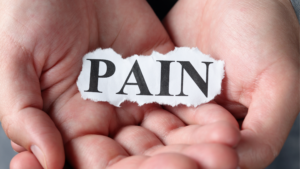 We look away from pain because it’s, well, painful. It hurts, and we don’t like it. And when it comes down to it, we do a whole lot of things to prevent feeling it, sometimes to our own detriment. We believe, deep down, that pain is bad and something to be avoided. While difficult to endure, pain is a powerful and important signal, often that something bad is happening like tissue damage in the case of a sprained ankle and heartbreak in the case of Ukraine. Pain is also a signal of what is important to us. It lets us know what we care about. It can galvanize us to action to remedy a problem. Perhaps that means resting to allow an injury to heal or taking a stand to force systemic change.
Sometimes, though, there is nothing that can be done to fix the problem. Sometimes bad things happen. In this life, pain is unavoidable. That doesn’t mean there is nothing we can do, though. We can hold space for that pain. We can, if we have the courage, look pain in the eye without shying away. And in doing so, we connect as humans, providing support and solidarity in what can be an isolating experience.
I am open about having a degenerative retinal disease. Over the years, I’ve had lots of friends and acquaintances ask me about my vision and what I can and can’t see. Some are brave enough to ask if it’s gotten worse when we catch up after a time, but only two to date have looked me in the eyes and asked if I will go blind. It’s a hard question to ask and to be asked because the answer has the potential to be heavy, and most people seem hesitant to venture into that kind of emotional territory. While I was initially taken aback by their bold move of leaning into rather than sidestepping around my pain point, the experience of having someone willingly wade into those waters with me was profound.
Holding space for pain
A lot of the psychological strength training we do at Peak Mind centers on emotional intelligence: understanding and navigating your emotions in a healthy way. A big component of that is being able to make space for pain, to stand, open, in the face of it. To take its message and act in alignment with your values, even though it might be difficult. This is a time when we need to do that. We need to have the courage to hold space for the pain in the world, to look it in the eye, to say I am here—with you—and I won’t turn away.
I am reminded of an experience I had as an intern at a Children’s hospital. I was in the room with a 17-year-old when she received the diagnosis of fatal bone cancer. It was devastating – to her, to her family, to witness. As a psychologist-in-training, I wanted to help, but what could I do to fix the problem? Unlike anxiety where I can teach people skills to help reduce their symptoms and they can get better, there was no getting better here. The cancer wasn’t going away. I felt powerless and useless. But I learned an important lesson. My supervisor helped me understand that sometimes the only thing you can do is hold space for someone’s pain, to not shrink away from it or minimize it, to sit in it with them, to say, “This sucks. I’m here with you, and you don’t have to filter.” And that doing so is a gift…albeit sometimes an incredibly difficult one to give.
As Brené Brown says in Braving the Wilderness, we need to move through the world with a “strong back, soft front, and wild heart.” We need the courage to stand tall and the willingness to be vulnerable, to acknowledge what is real and true, even when it hurts. To allow ourselves to embrace pain and the message and beauty that it can bring, if only we have the courage. We need to be willing to look at our loved ones, our coworkers, our neighbors, and strangers with compassion, to say, “I see your pain. It is real, and it is hard. And I am here, in it, with you.”
About the author
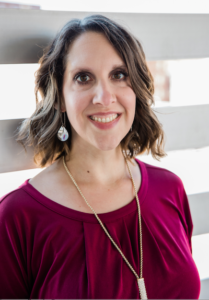 Dr. Ashley Smith is a licensed clinical psychologist with expertise in the treatment of anxiety and OCD. She has worked in Children’s hospitals, an anxiety specialty center, and now private practice. She’s the author of the wonderful book, The Way I See It, among other publications. She provides trainings on local and national levels and is the co-founder of Peak Mind: The Center for Psychological Strength. Dr. Ashley is passionate about using psychology, applied neuroscience, and life design to help others live vibrant, joyful lives.

2 Comments on Guest post: I see your pain.
Such a great article! Holding space is about all we can do sometimes AND it is everything.
The content was well explained and described. This article is a “must-read” article. Great work, thank you for sharing this.